An instrument sounds different in different musical environments. Our perception of a sound source is different in a cave or a concert hall or an apartment or in the woods. Instruments can sound different at night than during the day depending on where you are. Changes in temperature make it necessary to tune and take care of instruments.
Most instruments are affected by the environments they are in. Digital instruments are an exception.
What if environmental variations became factors in the sonic design of digital instruments?
Imagine a digital instrument with sonic design derived from local information:
- time of day (or day of month, month of year, or all of the above)
- temperature (around instrument, or in the town today, or the average of last week's temps in town)
- weather (would rain, sun, snow, wind, fog, etc make a difference?)
- place (GPS coordinate/city/state/country/continent?)
What physical form would an instrument like this take? What does an ever changing sonic identity mean for (probably) static physical identity? Would a strong physical identity be distracting or helpful for this kind of sonic identity?
I am intrigued with this idea of having an instrument that has an ever changing sonic identity. I laugh at the thought of someone asking "So... what does it sound like?" and me saying "I have no clue! We'll find out won't we!"
Yet, in order for an instrument like this to be successful there must be ways to control the instrument in at least slightly predictable ways. The sound and/or control could still be affected by the environment, but the performer must know what's going on. (at least a little bit)
I imagine performing with this instrument would be great fun in the setting of a worldwide tour. I have a lot more ideas about the implications of this kind of system, but I'll leave it here for now...
Monday, January 18, 2016

Saturday, January 16, 2016
Initial Jitters
I have an admission to make; I find the process of thinking of novel interfaces to be very difficult. I'll design bespoke instruments all day long, but the interface with those instruments are in no way novel; if it isn't completely programmed or programmed in MIDI, than I'll use standard interfaces like drum pads or piano style keyboards, or sometimes going further back to simple analog knobs and switches if that is all the mechanism calls for. It's always been the aural and visual outcome rather than the feel of the input that I have concentrated on. That being said, I've never shied from challenge, so we sally forth.
In my initial thoughts on the problem, I started to recognize some basic needs which were key to me: should it be discrete verses continuous control? Can I have both? Will I be designing an interface and then finding a family of sounds that suited that interface, or is it the inverse; do I want a particular set of sounds and then I design the interface to suit them? Does it aid in musical execution and or lead to new creative avenues? And the most vexing to me of all because I have quite a bit of experience in music but almost none in design, what does it look like? How does it feel?
The difficulty in the question of discrete versus continuous control is this: when I design an array of buttons to give me the same amount of discrete pitch control that I would have in a traditional instrument there are two outcomes, and neither of them are satisfactory. The first outcome would be to just copy the fingering system from a traditional instrument, but then you have something derivative at best and a copy at worst; nothing novel there, might as well go with the original. The second option is to come up with a fingering system from first principles, a fingering system that was easy to use and at the same time allows access to multiple octaves and is flexible enough to suit virtuosic execution. I have seen several systems which were interesting and could support virtuosic playing before; for instance I have tinkered with the C-Thru Music controller,
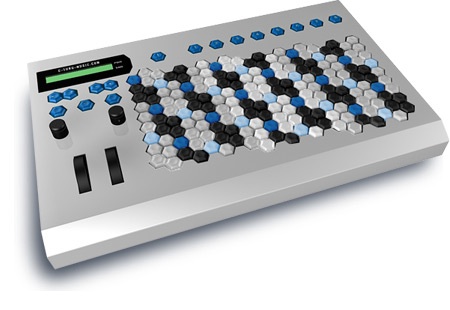 which was an interesting and engaging interface, but as I was already experienced in both piano and saxophone, a MIDI keyboard or a MIDI wind controller suited me much better. Maybe I missed out on some new understanding of harmony using the C-thru, but I didn't have the time. That's the thing about a new discrete interface: it's a lot like the language Esperanto, well conceived, rationally constructed, made with all the best intentions, but it's nobody's native language and so remains of interest only to a small group of enthusiasts. Maybe that's why the C-thru has gone out of production.
A continuous controller seems a more productive route, yet it too can be musically limiting. In a gross simplification, a continuous controller is nothing but a variation on the mod or pitchbend wheel on a classic MIDI keyboard. There are strategies for getting around or compensating for this, but limitations remain. There are historical instruments with continuous aspects that can be played virtuosically; standard string instruments have no frets, the trombone has a slide. But once again you run the risk of making something derivative that would best be done with the original. It is imperative that some method of controlling an ADSR envelope be included in the design lest you sweep glissandi every time you change pitches or parameters.
There is of course a third way out of this dilemma, and that is using non-tonal or non-musical sounds only with your controller. While I am an enthusiast and practitioner of that aesthetic, it becomes problematic when combined with novel interfaces. Often the audience, and frequently even the musician, have a hard time decoding the relationship of the gesture on the interface with the audio result. In a live performance situation, too much novelty at once loses the musical link between what is happening on stage and it's place in historical and cultural context: we can take audio chaos in a live performance if it's apparent how the musician is doing it or we can take alien gestures on an interface as long as the gestures translate into meaningful audio effect, but both at the same time are just too much.
Which came first, the sound or the interface? This is a more philosophical question than a practical one. Of course, on any sort of musical instrument digital interface, you can assign whatever sound you want to whatever MIDI note or CC you assign to it, and the same holds true on any novel interface. That being said, and once again falling back on the metaphor of standard instruments, can you write a legitimate heave metal guitar line on a piano keyboard even with the top of the line software instruments, effects and amp modeling? Or is there something intrinsic about the way the intervals on the strings are laid out that would make playing the lines on the piano clunky where they flow effortlessly off the guitar?
My initial reaction as a musician is that, since ultimately the sound is the point of a musical endeavor, then the sound should come first. Once it's been decided musically what needs to be achieved, then you design the tool that allows you to most easily achieve it. But I wonder; through history, was every new instrument design based totally on the sound it would achieve? Could it have been that new sounds were made when the designer was just trying improve on the playability of an existing instrument, or just improve one particular aspect of an existing instrument? Was Cristofori intending to make a whole new timbre with his piano-forte, or just simply trying to get the damn harpsichord to have some dynamics and sustain? Did people say 'Nice trick Bart, but it doesn't really sound like a harpsichord anymore'?
So, while sound is obviously important, I'm tending towards interface first for a couple of reasons. One is that we have the freedom to assign any sound we want to it, so I'm sure there is something out there that can be made to suit. The second is that it's interesting to imagine the feel of a new instrument, how it hefts in your hand, how fast the action is, what motions are necessary and how their comfort (or lack thereof) contribute to the musical act and ultimately to the sound. This also leads to my next question from the introduction; how does it aid creativity? While I can and do think up new sounds and compositions quite comfortably on standard interfaces, maybe throwing something different in will lead to some new explorations, akin to a relatively tonal composer throwing some Serialism in to a transition just to shake things up.
I only know one Design dictum that I would hold to; Form and Function are one. As soon as you stray from that, superfluity begins to creep in. I was shocked the first time I found out that all the brilliant pillars and cornices of 18th century Italian architecture had nothing to do with the structure and were completely facade; it turned soaring heroic buildings into carnival displays. I am the opposite of Rococo (though I do have an occasional weakness for tasteful filigree). Beyond that, I haven't thought too much about the design of things. Either a thing works well or it doesn't, it's appearance is of little consequence. So when it came time to design something, I had to go fishing for inspiration.
I turns out this is harder than I thought. While the last century heralded a major explosion of interesting gizmos and clever solutions for modern living, currently most of those gizmo's utility has been usurped by the Swiss Army Knife of technological interaction, the touch screen. So many interactions have been brought under the sway of our thumbs that there are few examples of any sort of interface that doesn't include them. Even in all the major design blogs Ix/Ux are coding problems, not physical objects. The few places where I could find innovation in physical interactions involved jobs where people are still obliged to use their hands: tools and medical. Even in these cases, there aren't very many revolutionary advances, more tooling about the edges of proven designs: it's hard to improve on a drill motor.
So trapped between the ubiquitous history of musical instrument design on one side and the monolith of the touch screen on the other, I repeat my original concern, I find the process of thinking of novel interfaces to be difficult. It needs to be succinct, original, meaningful and done in a month or so. That being said, I've never shied from a challenge.
In my initial thoughts on the problem, I started to recognize some basic needs which were key to me: should it be discrete verses continuous control? Can I have both? Will I be designing an interface and then finding a family of sounds that suited that interface, or is it the inverse; do I want a particular set of sounds and then I design the interface to suit them? Does it aid in musical execution and or lead to new creative avenues? And the most vexing to me of all because I have quite a bit of experience in music but almost none in design, what does it look like? How does it feel?
The difficulty in the question of discrete versus continuous control is this: when I design an array of buttons to give me the same amount of discrete pitch control that I would have in a traditional instrument there are two outcomes, and neither of them are satisfactory. The first outcome would be to just copy the fingering system from a traditional instrument, but then you have something derivative at best and a copy at worst; nothing novel there, might as well go with the original. The second option is to come up with a fingering system from first principles, a fingering system that was easy to use and at the same time allows access to multiple octaves and is flexible enough to suit virtuosic execution. I have seen several systems which were interesting and could support virtuosic playing before; for instance I have tinkered with the C-Thru Music controller,
A continuous controller seems a more productive route, yet it too can be musically limiting. In a gross simplification, a continuous controller is nothing but a variation on the mod or pitchbend wheel on a classic MIDI keyboard. There are strategies for getting around or compensating for this, but limitations remain. There are historical instruments with continuous aspects that can be played virtuosically; standard string instruments have no frets, the trombone has a slide. But once again you run the risk of making something derivative that would best be done with the original. It is imperative that some method of controlling an ADSR envelope be included in the design lest you sweep glissandi every time you change pitches or parameters.
There is of course a third way out of this dilemma, and that is using non-tonal or non-musical sounds only with your controller. While I am an enthusiast and practitioner of that aesthetic, it becomes problematic when combined with novel interfaces. Often the audience, and frequently even the musician, have a hard time decoding the relationship of the gesture on the interface with the audio result. In a live performance situation, too much novelty at once loses the musical link between what is happening on stage and it's place in historical and cultural context: we can take audio chaos in a live performance if it's apparent how the musician is doing it or we can take alien gestures on an interface as long as the gestures translate into meaningful audio effect, but both at the same time are just too much.
Which came first, the sound or the interface? This is a more philosophical question than a practical one. Of course, on any sort of musical instrument digital interface, you can assign whatever sound you want to whatever MIDI note or CC you assign to it, and the same holds true on any novel interface. That being said, and once again falling back on the metaphor of standard instruments, can you write a legitimate heave metal guitar line on a piano keyboard even with the top of the line software instruments, effects and amp modeling? Or is there something intrinsic about the way the intervals on the strings are laid out that would make playing the lines on the piano clunky where they flow effortlessly off the guitar?
My initial reaction as a musician is that, since ultimately the sound is the point of a musical endeavor, then the sound should come first. Once it's been decided musically what needs to be achieved, then you design the tool that allows you to most easily achieve it. But I wonder; through history, was every new instrument design based totally on the sound it would achieve? Could it have been that new sounds were made when the designer was just trying improve on the playability of an existing instrument, or just improve one particular aspect of an existing instrument? Was Cristofori intending to make a whole new timbre with his piano-forte, or just simply trying to get the damn harpsichord to have some dynamics and sustain? Did people say 'Nice trick Bart, but it doesn't really sound like a harpsichord anymore'?
So, while sound is obviously important, I'm tending towards interface first for a couple of reasons. One is that we have the freedom to assign any sound we want to it, so I'm sure there is something out there that can be made to suit. The second is that it's interesting to imagine the feel of a new instrument, how it hefts in your hand, how fast the action is, what motions are necessary and how their comfort (or lack thereof) contribute to the musical act and ultimately to the sound. This also leads to my next question from the introduction; how does it aid creativity? While I can and do think up new sounds and compositions quite comfortably on standard interfaces, maybe throwing something different in will lead to some new explorations, akin to a relatively tonal composer throwing some Serialism in to a transition just to shake things up.
I only know one Design dictum that I would hold to; Form and Function are one. As soon as you stray from that, superfluity begins to creep in. I was shocked the first time I found out that all the brilliant pillars and cornices of 18th century Italian architecture had nothing to do with the structure and were completely facade; it turned soaring heroic buildings into carnival displays. I am the opposite of Rococo (though I do have an occasional weakness for tasteful filigree). Beyond that, I haven't thought too much about the design of things. Either a thing works well or it doesn't, it's appearance is of little consequence. So when it came time to design something, I had to go fishing for inspiration.
I turns out this is harder than I thought. While the last century heralded a major explosion of interesting gizmos and clever solutions for modern living, currently most of those gizmo's utility has been usurped by the Swiss Army Knife of technological interaction, the touch screen. So many interactions have been brought under the sway of our thumbs that there are few examples of any sort of interface that doesn't include them. Even in all the major design blogs Ix/Ux are coding problems, not physical objects. The few places where I could find innovation in physical interactions involved jobs where people are still obliged to use their hands: tools and medical. Even in these cases, there aren't very many revolutionary advances, more tooling about the edges of proven designs: it's hard to improve on a drill motor.
So trapped between the ubiquitous history of musical instrument design on one side and the monolith of the touch screen on the other, I repeat my original concern, I find the process of thinking of novel interfaces to be difficult. It needs to be succinct, original, meaningful and done in a month or so. That being said, I've never shied from a challenge.
I've been thinking about how to make an instrument respond to the performer. Though it could be said that a lot of DMIs are "dead", compared with physical, vibrating acoustic instruments, I think there is potential to use technology to imbed even more feedback/vibe/whatever into a performance device.
Looking through this paper on actuated instruments, I came across the Overtone Fiddle (a project I've previously heard of but had forgotten). This I think (regardless of the aesthetic of performance and design) is a good model for what I'm looking for!
Study No. 1 for Overtone Fiddle from Alexander Refsum Jensenius on Vimeo.
Looking through this paper on actuated instruments, I came across the Overtone Fiddle (a project I've previously heard of but had forgotten). This I think (regardless of the aesthetic of performance and design) is a good model for what I'm looking for!
Study No. 1 for Overtone Fiddle from Alexander Refsum Jensenius on Vimeo.
Friday, January 15, 2016
Music for Lamps and Surface Transducers
When brainstorming ideas for instruments, I thought back to a performance during the MATA festival in NYC that I saw last year, entitled Music for Lamps. Max Stein, Julian Stein, and Adam Basanta were the composers/engineers/performers of the piece, and you can read more about them and the project at their documentation hub here.
I remember that two things really struck me about the performance: 1) I loved the use of the "vintage" lamps. Like the Music for Lamps team, I am also interested in re-contextualizing everyday objects and imagining my own sound worlds in which to place them. Their fine control over dimming the lights, or abruptly turning them on and off created some exquisite moments of multimedia drama. 2) I was most impressed that sound was actually admitted from the lamps, in combination with a pair of overhead monitors. I spoke with the team briefly, afterwards and they explained that they attached surface transducers to the bottoms of the lamp so that they would resonate with whatever audio they sent through MaxMSP.
I love the idea of using surface transducers, and I think that will play a role in my projects for this semester. I think a lot of audiences find electronic music performances limiting when sound only comes from a pair of overhead stereo monitors. WhileMusic for Lamps probably won't work as a direct model for the digital musical instrument project (for a few reasons, e.g. there is no physical/immediate relationship the performer has to the system of lamps, rather it's mediated through MaxMSP), it served as a nice starting point for my thinking. Below you'll find a link to a full performance of Music for Lamps, the composition is pretty improvisatory so each performance will differ. I hope you enjoy!
I remember that two things really struck me about the performance: 1) I loved the use of the "vintage" lamps. Like the Music for Lamps team, I am also interested in re-contextualizing everyday objects and imagining my own sound worlds in which to place them. Their fine control over dimming the lights, or abruptly turning them on and off created some exquisite moments of multimedia drama. 2) I was most impressed that sound was actually admitted from the lamps, in combination with a pair of overhead monitors. I spoke with the team briefly, afterwards and they explained that they attached surface transducers to the bottoms of the lamp so that they would resonate with whatever audio they sent through MaxMSP.
I love the idea of using surface transducers, and I think that will play a role in my projects for this semester. I think a lot of audiences find electronic music performances limiting when sound only comes from a pair of overhead stereo monitors. WhileMusic for Lamps probably won't work as a direct model for the digital musical instrument project (for a few reasons, e.g. there is no physical/immediate relationship the performer has to the system of lamps, rather it's mediated through MaxMSP), it served as a nice starting point for my thinking. Below you'll find a link to a full performance of Music for Lamps, the composition is pretty improvisatory so each performance will differ. I hope you enjoy!
Thursday, January 14, 2016
Reflecting on the digital...
I've been doing a lot of reflecting recently on digital vs. analog spaces and how the digital online space in particular is changing our interactions with technology and also with each other. There's a constant search for the next new innovation or revolutionary piece of technology, and we've been reconditioned to crave immediacy and satisfaction. There are physical buttons you can order on Amazon that are linked to your credit card that will automatically reorder things from groceries to gatorade to diapers and toilet paper. With a simple press of a button, your order is placed and shipped to you within a couple of days. Social media has also conditioned us to crave that immediacy; many people receive the world's latest news through the online spaces they occupy; we habitually check our email and online profiles for updates, messages, likes, etc. The technological revolution has placed us in a position that no other generation has seen before; we are moving so rapidly that we can't seem to stop.
A couple of months ago, I ordered Douglas Coupland's new book, The Age of Earthquakes. Douglas Coupland is one of my favorite authors (and also Canadian!) and he often talks about how technology is changing (for lack of a better term) the human condition. Here are some of my favorite pages from the book (although the whole thing is amazing and I highly recommend reading it):


So where am I going with all this?
I think the development of music is reflecting this rapid unstoppable acceleration. We have apparently reached a point where physical acoustic instruments have largely been exhausted, so we've moved into the digital space, where it's faster, easier and more widely accessible to "create" music. Thanks to technology, you can synthesize apiano [insert other instrument here] track fairly quickly--much quicker than going through the motions of actually learning how to play the piano [other instrument].
Traditional classical instruments have evolved over hundreds and hundreds of years to reach where they are today. You can trace many instruments' lineages all the way through to the medieval ages. I think that the process of learning these instruments reflects that reiteration and refining; it takes years and years and years to master one of these more "traditional" instruments.
On the other hand, due to our obsession with pushing soundscapes and rapidly creating something NEW, new age instruments are lacking that same identity. Yes, we might put a lot of time (and thought and iteration) into creating a "new" instrument or interface to play music, whether that sound is created through digital or analog means. However, these new instruments or interfaces aren't receiving the same opportunity to evolve and grow and root themselves in a history, because of our fascination with innovation and rapidity. I mean, classical instruments went through the iterative design process, just drawn out over hundreds of years. So we're being called to design and create new instruments/interfaces, and yet you can see these new interfaces often being dropped or left behind after only a few months or a few years of development.
All of this ties into what Professor Gurevich has said about finding an identity for our proposed designs and finding an established aesthetic or tradition to root it into. How do my initial ideas relate to art movements or already existing instruments? What do I want the sonic/visual aesthetic of my instrument to be? Do my designs leave space for the instrument to grow and develop? Does it require the user to develop a certain kind of skill? How can I challenge myself to push back against this rapid acceleration and reflect that in my design?
A couple of months ago, I ordered Douglas Coupland's new book, The Age of Earthquakes. Douglas Coupland is one of my favorite authors (and also Canadian!) and he often talks about how technology is changing (for lack of a better term) the human condition. Here are some of my favorite pages from the book (although the whole thing is amazing and I highly recommend reading it):

Right: Proceleration (n.) The acceleration of acceleration.

Right (gray box): Fact: The internet makes you smarter and more impatient. It makes you reject slower processes invented in times of less technology: travel agencies; phone calls; reference libraries; nightclubs.


(I thought the right page was a big ironic)
So where am I going with all this?
I think the development of music is reflecting this rapid unstoppable acceleration. We have apparently reached a point where physical acoustic instruments have largely been exhausted, so we've moved into the digital space, where it's faster, easier and more widely accessible to "create" music. Thanks to technology, you can synthesize a
Traditional classical instruments have evolved over hundreds and hundreds of years to reach where they are today. You can trace many instruments' lineages all the way through to the medieval ages. I think that the process of learning these instruments reflects that reiteration and refining; it takes years and years and years to master one of these more "traditional" instruments.
On the other hand, due to our obsession with pushing soundscapes and rapidly creating something NEW, new age instruments are lacking that same identity. Yes, we might put a lot of time (and thought and iteration) into creating a "new" instrument or interface to play music, whether that sound is created through digital or analog means. However, these new instruments or interfaces aren't receiving the same opportunity to evolve and grow and root themselves in a history, because of our fascination with innovation and rapidity. I mean, classical instruments went through the iterative design process, just drawn out over hundreds of years. So we're being called to design and create new instruments/interfaces, and yet you can see these new interfaces often being dropped or left behind after only a few months or a few years of development.
All of this ties into what Professor Gurevich has said about finding an identity for our proposed designs and finding an established aesthetic or tradition to root it into. How do my initial ideas relate to art movements or already existing instruments? What do I want the sonic/visual aesthetic of my instrument to be? Do my designs leave space for the instrument to grow and develop? Does it require the user to develop a certain kind of skill? How can I challenge myself to push back against this rapid acceleration and reflect that in my design?
Wednesday, January 13, 2016
Imogen Heap + Ariana Grande + Mimu Gloves
From what I've gathered so far, there has definitely been a lot of discussion amongst the PAT department about Imogen Heap's Mimu gloves. They definitely seem to function more as a controller than instrument in my opinion, especially due to the fact that they can be applied across such a wide variety of instrument sounds. One thing that they do great, however, is create new ways to perform music and control effects.
While looking more into Imogen Heap's work I actually came across a video of pop musician Ariana Grande performing live with Mimi gloves. There are actually several videos of her doing this at different concerts, so she did it on at least one of her tours.
Here are a couple videos (I apologize in advance, as the quality is not great on all of them):
(In this second video, anything regarding the gloves is done after about 3:30)
In the second video, you can see there is actually in introduction by Imogen Heap about the gloves, which also features a video of Ariana doing a cover of an Imogen Heap early in her career. The video isn't perfect, but one thing I really take away from it is how the crowd reacts to the different ways the effects are controlled (even though the screams are very annoying). What I think is great about this is it shows young people reacting to new performance system that have been featured at NIME. This shows that these new systems can be accessible at a greater scale if we want them to be. I find this exciting, because so many great things are done in developing new interfaces and instruments but I feel that sometimes they don't get introduced to large enough audiences.
There is also a "tour diaries" video that shows Ariana Grande practicing with the gloves. In this video she clearly is having the gloves interface with a voicelive touch 2 vocal effects processor. I have used these processors many times, and based on what I know, the effect Grande is getting are coming from the voicelive. Basically, she just uses the gloves as a 3D control. Another thing I noticed is that her gestures are very limited, and I wonder whether she lacks skill or if there is just not that much to control. Here's the video:
While looking more into Imogen Heap's work I actually came across a video of pop musician Ariana Grande performing live with Mimi gloves. There are actually several videos of her doing this at different concerts, so she did it on at least one of her tours.
Here are a couple videos (I apologize in advance, as the quality is not great on all of them):
(In this second video, anything regarding the gloves is done after about 3:30)
In the second video, you can see there is actually in introduction by Imogen Heap about the gloves, which also features a video of Ariana doing a cover of an Imogen Heap early in her career. The video isn't perfect, but one thing I really take away from it is how the crowd reacts to the different ways the effects are controlled (even though the screams are very annoying). What I think is great about this is it shows young people reacting to new performance system that have been featured at NIME. This shows that these new systems can be accessible at a greater scale if we want them to be. I find this exciting, because so many great things are done in developing new interfaces and instruments but I feel that sometimes they don't get introduced to large enough audiences.
There is also a "tour diaries" video that shows Ariana Grande practicing with the gloves. In this video she clearly is having the gloves interface with a voicelive touch 2 vocal effects processor. I have used these processors many times, and based on what I know, the effect Grande is getting are coming from the voicelive. Basically, she just uses the gloves as a 3D control. Another thing I noticed is that her gestures are very limited, and I wonder whether she lacks skill or if there is just not that much to control. Here's the video:
Overall, I think it is great that a new interface like this is getting exposure in the realm of popular music. It is not nearly enough, but it is a good start. I think this also might motivate some people to consider how are instruments could be used on a larger stage. It would be really cool to keep seeing things like this show up in pop music, and even cooler to see it get better.
I would love to hear that thought of others regarding this. For or against, I think it is definitely something worth talking about.
Tuesday, January 12, 2016
Concept: Digital Hurdy Gurdy
I've been thinking for a while about the possibility of a digital hurdy gurdy, an instrument that generates sound from a spinning wheel (hand cranked) that excites three types of strings: melodic, drone, and percussive.
Here's my initial sketch

I decided to do some research on the hurdy gurdy and found that Derek Holzer has made an electronic one (though there's no computer or microcontroller inside). His electric hurdy gurdy is an offshoot from his Tonewheels project, and though it looks great I think there is plenty of room to expand on the concept. Details here: http://macumbista.net/?p=3020
His electric hurdy gurdy looks like this...

The design looks really solid and I love how it still looks (and essentially works like) a hurdy gurdy. If I decide to go through with this idea I would certainly reference Holzer's work.
Here's my initial sketch

I decided to do some research on the hurdy gurdy and found that Derek Holzer has made an electronic one (though there's no computer or microcontroller inside). His electric hurdy gurdy is an offshoot from his Tonewheels project, and though it looks great I think there is plenty of room to expand on the concept. Details here: http://macumbista.net/?p=3020
His electric hurdy gurdy looks like this...

The design looks really solid and I love how it still looks (and essentially works like) a hurdy gurdy. If I decide to go through with this idea I would certainly reference Holzer's work.
Subscribe to:
Posts
(
Atom
)