Oops I'm really silly and posted this on the ECM blog...
I decided to look into the different stick/tube controllers discussed in class on Tuesday and see what I thought of them. Unfortunately I couldn't find a video of the Sonic Banana, but I was able to find a few videos of the t-stick. This piece is called "Still Life: Eviction for soprano t-stick" (jeez).
My main problem with this was that the gestures didn't feel like they had any meaning, and the movements were very static. I'm hoping to explore bigger gestures that better reflect the sonic changes that result. I'm also looking to have a better visual component to my performance -- a longer tube with reactive LEDs.
Class blog for PAT 452/552 – Interactive Media Design II – Department of Performing Arts Technology
Sunday, January 22, 2017
Wednesday, January 18, 2017
Crystals and Meaning
For my latest explorations, I've been researching different stones and crystals, along with their metaphysical uses and meaning. This got me thinking of creating an instrument that had gestures and structures that were based on "crystal gazing" - when an individual looks into a crystal ball for images which have specific meanings for the future.
I've also been interested in holographics when I stumbled upon an installation that utilized a holographic projector to allow participants to control the image with their smart phones. I then came up with the idea of using a holographic projector to create the image that would be contained within a crystal ball.
I've posted my presentation of my influences and design schematics of this instrument below!
Sunday, January 15, 2017
Fiddling
I've been thinking a lot about the human tendency to fiddle with things, and how it often manifests in musical expression. So, I've started a list of tactile "things" that are the most fun for me. The first thing that came to mind was using the fingers of one hand to push the fingers of the other hand back, and vise versa. I'd like to try to replicate that movement.
I don't really want to make anything like the instrument in this video. However I find inspiration in its playfulness.
Friday, January 13, 2017
452 Project 1-Brainstorming/Research
Jan 11: Brainstorming/Research
For project 1, I brainstormed and came up with some brief ideas on interactions, materials usage, sound design and such.
First, I thought of some other nonconventional forms of interactions that human can involve with playing an instruments, such as pulling, squeezing, swinging objects,etc. However, of course, at this early stage, I have also thought about how "virtuosic' people could be if they are playing in those interactions with the instruments. I hope to make an instruments where people could get better and better with it, so it requires an actual "skill" to be "successful" on the instrument.
Secondly, I thought about what tangible/ intangible materials (objects as materials too) that I have and materials that I want to work with/explore. For example, some tangible materials would be wood, foams, light bulbs, stretchable bends, etc. As for the design sound, taking the advantage of technology, I came up with some aspects/ parameters that I want to include in the instruments by mapping it to a certain gesture (interaction with a sensor) so that users can edit it on the fly, such as tremolos/timbres/reversed envelope,etc.
Furthermore, I thought it would be an engaging action to see people pulling, and sounds will change according to the tension and force or speed that the player has given. Besides, I have recalled the Pendulum Music that we have studied in the past, and thought that would be a way to control certain parameters as well.
All of my points are a bit scattered now and very diverse, because I try not to confined myself to only one direction. However, hopefully, I can consolidate some of my ideas into one fine one and so I could proceed to some of the "thinking through making" process soon.
Here are some of my sketches to show my ideas.
Jaime
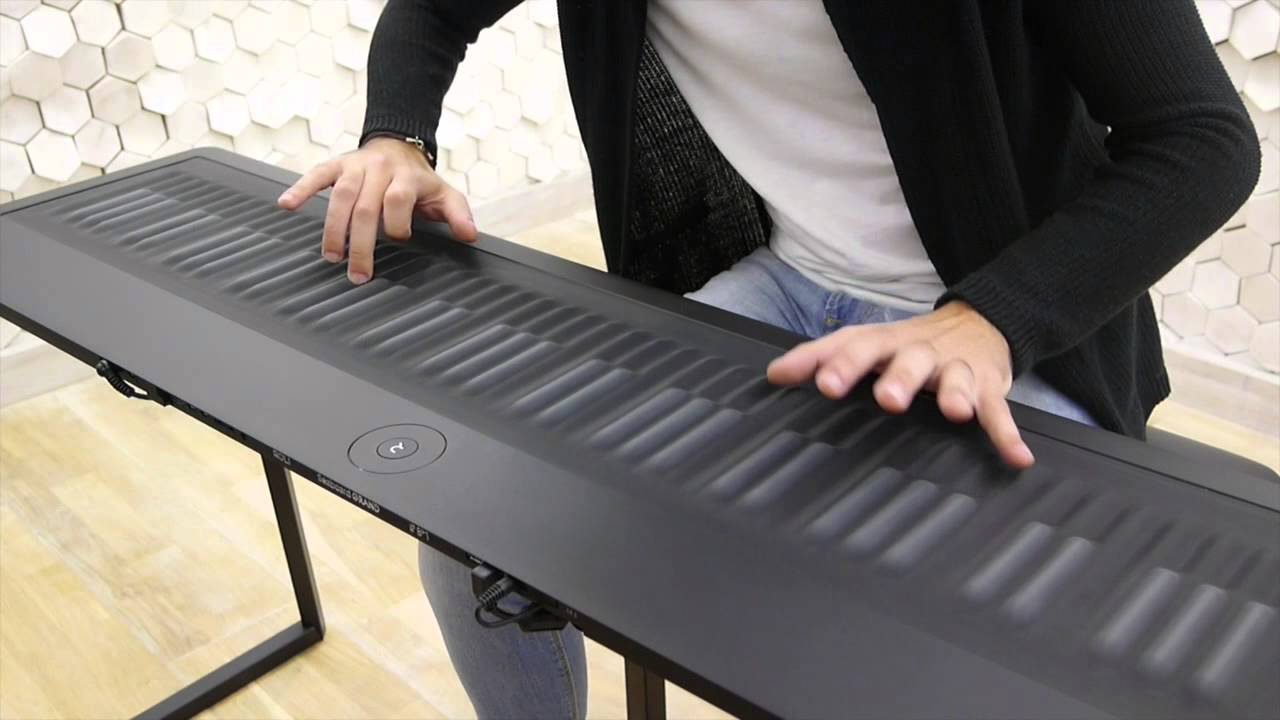
ROLI Seaboard
For project 1 inspiration, I've been looking at this instrument called the "Seaboard" made by the company ROLI. What impresses me most about this instrument is how much potential I think it has of becoming it's own separate entity. In other words, I feel like there could exist professional "Seaboard players". In essence, yes it is just an innovative keyboard that introduces new methods of expression. However I think the skill ceiling for these innovations is high enough that there is potentially for achieving virtuosity.
While I wasn't planning on recreating this instrument for my project (nor could I), it gave me a lot of ideas about how you can be expressive with just playing one note or chord. The specific idea I had was to use a more traditional method for triggering notes (buttons/sensors acting like keys), but then using something like a flex sensor to alter the timbre of the note after it has been played. I thought there existed a metaphor for say, clenching your fist and introduce gritty FM synthesis on an otherwise pure and delicate tone. To me, it expressive an anger or frustration sonically. I'm not sure just how large an array of keys I'll have yet, but I think just starting with one playable note that I can manipulate is a good start.
Friday, April 15, 2016
Working Demo
For this week I put together a working demo that successfully maps gestures performed on my spandex wall to a filter of ambient noise in MaxMSP. Getting to this point required figuring out the right interaction fabric so that a user could push into it without touching the wall, setting up a provisional lighting and camera set-up, and setting up white walls behind the fabric for contrast. It also took me a while to navigate Jaime Oliver's patch and successfully route the data to MaxMSP via a network port. Here is a video documenting the progress so far, with a simple right to left gesture mapped on to a bandpass filter of some cafe noise:
I had to take down the installation for this weekend's ECM concert, but I can get back to work on Sunday. Starting on Sunday, I will install a stronger light and set up the second camera for the vertical axis. From there I'll scale up to build my second wall and elaborate the sound design.
Saturday, April 2, 2016
A quicky this week:
Been working hard at using water as an interface, finally made some positive steps in that direction this afternoon. The first thing is a video of a mock-up of the actual patch that uses two video sources. The real patch uses a webcam on one side, but it was hard to make the video and move the water at the same time, so I made a quick recording of the water and used that recording to show the processing. The patch takes two sources and uses the method of lumakeying to blend them. A lumakey essentially takes all the pixels within a certain value of one video and makes them transparent, thus revealing the second video behind. So here's the video of the screen shot:
And the second is a video of the result projected on to a 4x8 piece of black burlap from about ten feet away. It makes the weird masking decision on the previous video make more sense:
Subscribe to:
Posts
(
Atom
)